
a hybrid AI
autonomous
trading system.
Advance Quantitative Research, Innovative Technology, and Institutional-Grade Risk Management
- Act IQuant's Windowthe view
- Act IIThe Gates, Measuredthe gates
- Act IIIAlgorithmic Cathedralthe discipline
- Act IVThe Bridgethe custody
- Act VTrading Floorthe supervisor
Five acts. Editorial pacing. Each anchored by a cinematic still and a single thesis. Scroll down — the program reveals itself in the order an allocator would ask the questions.
you've been trading without the supervisor.
After a combined fifty years inside institutional risk and finance — examining banks at the federal level, advising the largest G-SIBs through their hardest regulatory moments, building capital-markets and model-validation frameworks at trillion-dollar institutions — the gap was always the same. The discipline that protects institutional capital was never available to individual traders. Quant7 is what fixing that gap looks like.

the gates are measured, not asserted.
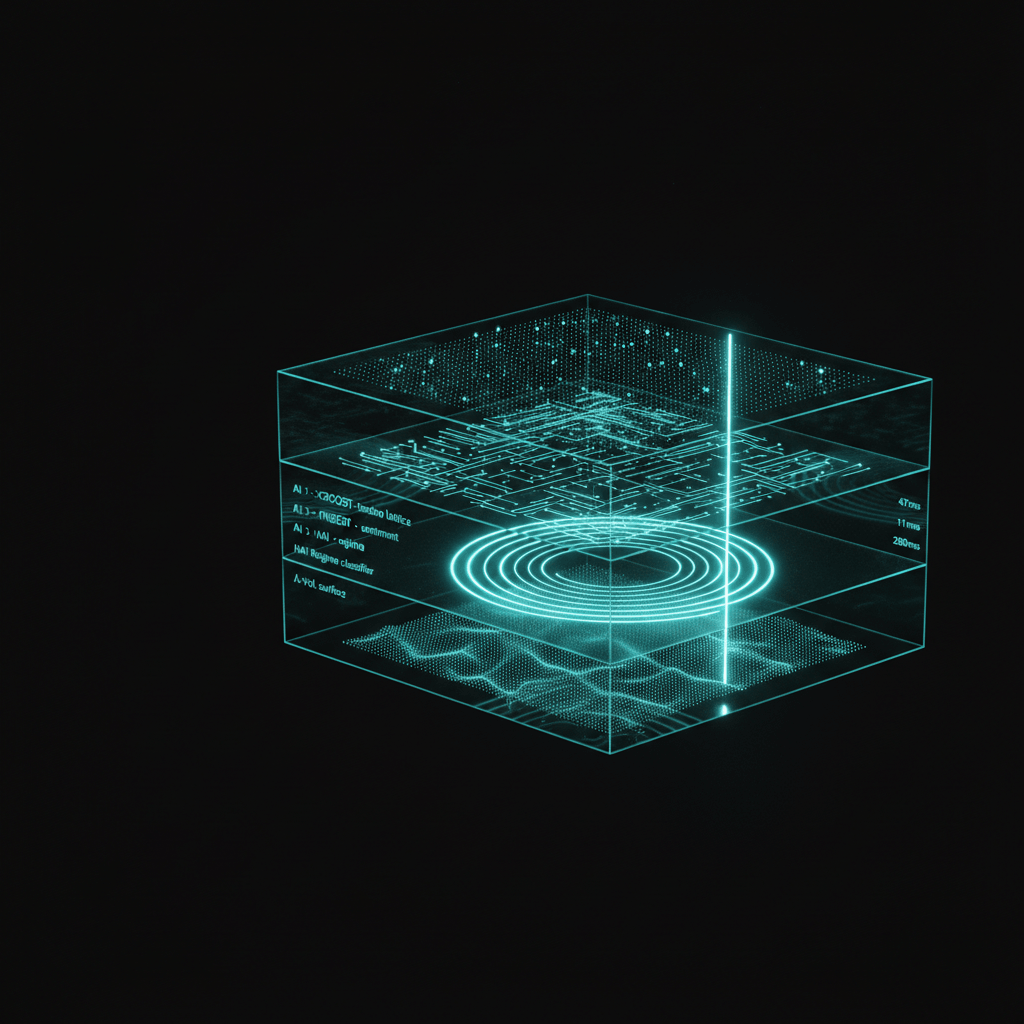
Three AI gates sit over the rule-based entry, each calibratable per configuration and each able to refuse a trade but never to authorise one: a gradient-boosted admissibility gate used as a veto rather than a directional forecast, financial-domain sentiment classification on real-time news and regulatory feeds, and twenty-day rolling regime detection per asset. Entry itself is decided by a six-component confluence score — a seventh component is specified and not yet built. Beyond those gates sits a research layer, and we measured it rather than advertising it: a perturbation census across 2,946 searchable dimensions returned 2,791 inert, because the enhancements had been wired as vote inputs, and a vote input reaches neither the exit ladder nor the risk budget. Q7's edge is not whether to trade; it is where the exits sit and how much size rides. Eight Q7-native constructs are now specified to route through the two paths measured to reach an executed outcome. None of them is enabled. Nothing ships at UNMEASURED.
- live gates
- 3 · veto-only · calibratable
- confluence
- 6 components · 7th specified
- research layer
- 2 of 12 reach the trade
- constructs
- 8 specified · 0 enabled
calibrated. not extrapolated.
Six systems live, a seventh in calibration. Ninety-six independently calibrated configurations live — one hundred twelve at full roadmap. Thirty thousand-plus independently optimized parameters across the system. Each configuration calibrated per asset, per timeframe, per regime by the q7_precision pipeline — Gaussian-Process Bayesian Optimization, with fifteen out-of-sample paths, statistical floor, Probabilistic Sharpe confirmation, Adaptive Conformal Inference for live drift correction. No black box. The SR 11-7 model-risk framework you'd find inside a G-SIB, applied end-to-end at the level of a single retail subscription.
- systems
- 6 live · 7th calibrating
- configurations
- 96 live · 112 roadmap
- parameters
- 30,000+
- audit framework
- SR 11-7
seven systems. seven markets.
Each system carries twenty-five calibrated subsystems drawn from a common pool — confluence scoring, regime classification, circuit breakers, ratchet exits, ζ-Field decomposition, and the rest. The asymmetry isn't in the count; it's in which subsystems activate. S7 AVA, trading binary outcomes on prediction markets, substitutes Event-CV Splitting for asset × timeframe CPCV and skips network-momentum, signature features, Λ-Vol KL decomposition, and DTW leader detection.
S7 AVA — AI-Augmented Volatility Arbitrage on prediction markets. Polymarket + Kalshi venue connectors, event-graph CV, binary-outcome PnL accounting. Calibrates around event boundaries — election outcomes, sports, economic surprises — instead of bar timeframes. see the S7 detail page →
algorithmic trading carries substantial risk of loss. past performance does not guarantee future results. Quant7 Alpha, LLC does not custody client assets, does not provide personalized investment advice, and is not a registered investment advisor.
a different shape of market.
a different shape of model.
S1-S6 trade continuous price series. S7 AVA trades binary outcomes — questions that resolve to 0 or 1. Did the Fed hike? Did the NFL game go over? Did Bitcoin close above forty-thousand on the deadline? The underlying mechanics are different enough that S7 carries its own engine taxonomy, its own CV protocol, and its own subsystem specialty within the common twenty-five-subsystem stack.
not TRND / BRK / MR / SWP.
S7 substitutes the four S1-S6 engines with a five-engine taxonomy adapted to event-driven order books and dual-venue CLOBs.
- E1LAT_ARBlatency arbitrage · cross-venue tick race
- E2MM_REBATEmarket-making · maker-rebate harvesting
- E3CROSS_VENUEpolymarket ↔ kalshi spread + funding capture
- E4INTRA_ARBsingle-venue YES/NO mispricing intraday
- E5NEWS_NLPFinBERT-tier NLP on real-time event newswires
no 4 × 4 grid. event boundaries instead.
S1-S6 enumerate 4 assets × 4 timeframes. S7 enumerates heterogeneous markets that resolve on event boundaries — ten crypto-binary + six event-driven.

your capital stays with you.
Always. The platform connects to your brokerage by trade-scope-only API keys — never withdrawal. Keys are AES-GCM encrypted at rest and never logged. The platform never holds funds. Period. You fund your own account, you keep your own custody, the system places trades through your credentials. We are the model. You are the bank.
- scope
- trade-only
- withdrawal
- never
- encryption
- AES-GCM
- platform custody
- zero

the system halts itself before drawdown earns its way to your account.
An agent-governance layer watches every position, every fill, every drift signal. Sixteen specialized agents run continuously — calibration, live execution, risk, governance — each with a charter, each auditable, each accountable to you via permanent decision-log entries. The Adaptive Repair Loop runs two parallel branches off every live trade: a drift branch (Drift Detector → HAI re-trainer) and a structural branch (Code Auditor → Code Repair). Both feed the same learning loop. The discipline doesn't take the night off.
- agents
- 16 · charter §1 user-supreme
- repair loop
- dual-branch · drift + structural
- audit
- permanent decision log
- SDC taxonomy
- 10-class · SDC-01..10
the papers
Every claim has a paper behind it.
A formal architecture paper for each of the seven strategies — edge thesis, the four engines, the order-flow leverage model, the risk stack, the hybrid-AI gate — plus the methodology paper that governs them all: how every parameter is proven before it touches capital. Read the thesis and design of any paper in full; subscribers read the complete papers on-site.v1.0 · June 30 2026
the discipline that protects institutional capital,
finally available to you.
Replace chance with intelligence.
The system is operated by Quant7 Alpha, LLC. SR 11-7 model-risk framework applied end-to-end. Self-custody by design. Trade-scope API keys only. AES-GCM encrypted at rest. Subscriptions billed monthly · cancel anytime.